One Month Into the War: The Five Pressure Points Facing MENA VC and How Stakeholders Can Respond
One month after the escalation of regional conflict, the central question facing investors is no longer whether venture capital will be affected, but where the first signs of pressure will appear.
Venture capital rarely reacts to geopolitical shocks immediately. Funding rounds often reflect decisions made months earlier, meaning the earliest signals of disruption typically appear first in investor behavior, capital allocation decisions, and deal formation dynamics before becoming visible in funding statistics.
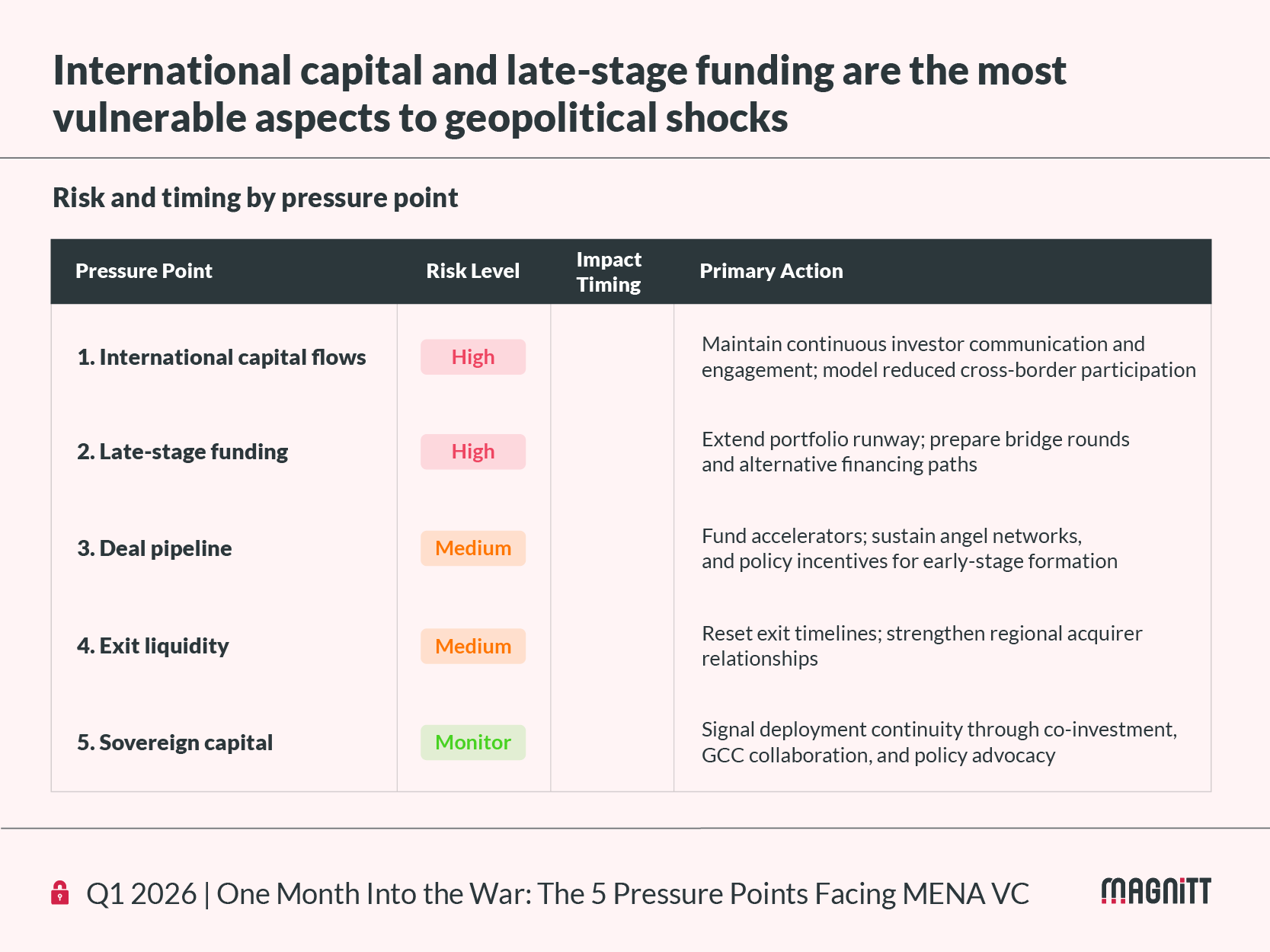
Following our previous report analyzing the potential impact of the war through three macro scenarios, this report provides a one-month update for the ecosystem. It introduces a framework that maps how geopolitical shocks transmit through venture capital and identifies five structural pressure points where disruption is most likely to emerge first.
For investors, founders, and policymakers, understanding these transmission channels provides an early warning system for how the current conflict could reshape capital flows, funding availability, and exit activity across the MENA venture ecosystem.
This report is a must-read for investors, founders, and policymakers seeking to understand how geopolitical shocks transmit into venture capital and where the earliest ecosystem pressures are likely to emerge.
What this report answers
MENA’s venture data still looks stable. That is the challenge. Venture markets react with a delay, meaning the real impact of geopolitical shocks often appears months after the initial disruption.
This report answers the questions investors, founders, and policymakers should be asking now:
- Which segments of venture capital are most exposed to geopolitical risk?
- How does the shock transmit from macro conditions into funding and exits?
- What should investors monitor to understand which scenario is unfolding?
- How should founders and investors position ahead of delayed market impact?
📊 Key Takeaways
- International capital is the ecosystem’s most immediate vulnerability. Global investors accounted for roughly half of all venture funding in MENA in 2025, making cross-border capital flows one of the earliest indicators of potential ecosystem slowdown.
- Late-stage rounds are structurally the most exposed to global shocks. International investors deployed the majority of capital in Series A and growth-stage funding, meaning even small changes in global investor participation can quickly affect scaling startups.
- Exit markets may react before funding statistics. Since nearly one quarter of venture exits since 2021 involved international acquirers, geopolitical uncertainty can delay acquisitions and IPOs before funding declines become visible.
- Startup pipeline pressure appears gradually rather than immediately. Historically only 7.3% of startups progress from early stage to Series A, meaning more selective capital environments can quickly narrow the pool of companies reaching scale.
- Sovereign and domestic capital can act as stabilizing forces. Government-backed investors and regional capital providers may help sustain venture activity when international participation becomes more cautious.
🎯 Who Should Read This Report
This report is designed for stakeholders navigating uncertainty and positioning ahead of potential venture market shifts.
- VCs & LPs assessing exposure to international capital flows and late-stage funding risk
- Founders & operators preparing for longer fundraising cycles and shifting investor behavior
- Policymakers & ecosystem leaders monitoring ecosystem resilience and capital stability
- Advisors & consultants supporting strategic decision-making across capital deployment and growth
Where is this data from?
The report was created using data from MAGNiTT, the leading VC and PE data platform across the Middle East, Africa, Pakistan, Türkiye, and Southeast Asia. With data on 34,800+ startups, 22,500+ funding rounds, and 1,300+ exits, MAGNiTT offers a comprehensive directory of technology innovation trends. Learn how MAGNiTT can help your business today!