MENA Ecosystem Benchmarking Index 2021–2025
MENA’s venture ecosystem has expanded considerably over the past five years, but that development has not been evenly distributed. Some markets have built deeper pools of capital, investors, growth-stage companies, and exit pathways, while others remain dependent on a narrower base of activity.
The concentration is significant. Just three markets account for 91% of the $14.6B raised across MENA’s 12 core venture markets between 2021 and 2025, and every active unicorn at the end of 2025 was headquartered in those same three ecosystems. Yet the data also shows that strong macroeconomic conditions alone do not guarantee equivalent venture-market depth.
The MENA Ecosystem Benchmarking Index creates a consistent way to measure that difference. By looking beyond funding alone to ecosystem scale, exits, investor participation, and the wider economic environment, the index provides a more complete view of how venture markets across the region compare and what each needs to develop next.
📊 Key Takeaways
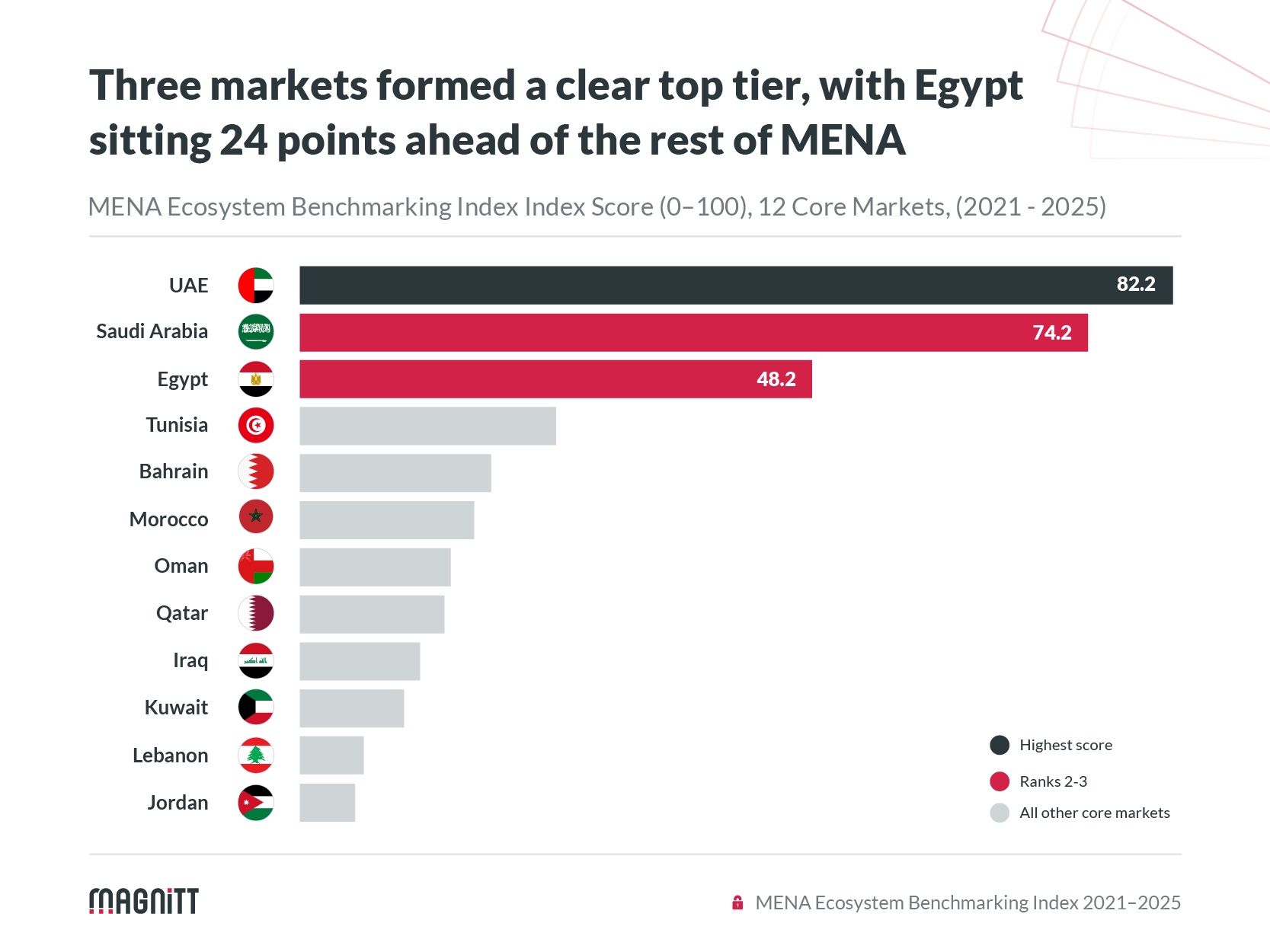
The index reveals that MENA’s venture divide is driven less by macroeconomic conditions alone and more by whether markets have developed capital depth, later-stage pathways, exits, and sustained investor participation.
- Three ecosystems have separated materially from the rest of the region. The UAE scores 82.2, Saudi Arabia 74.2, and Egypt 48.2. The 24.1-point gap between Egypt and Tunisia is larger than the entire range covering the nine markets below third place.
- Capital concentration is even greater than the scores suggest. The UAE, Saudi Arabia, and Egypt captured 91% of the $14.6B raised across the 12 core markets between 2021 and 2025, with the UAE and Saudi Arabia alone accounting for 76%.
- Growth-stage depth remains concentrated in two markets. Nine ecosystems recorded at least one Series B+ transaction, but Saudi Arabia and the UAE accounted for 87% of the capital deployed at that stage. The challenge for other markets is therefore not simply reaching Series B+, but creating recurring activity beyond isolated transactions.
- Strong macroeconomic conditions do not automatically create venture depth. Qatar and Kuwait score comparatively well on the macroeconomic pillar but remain materially lower on venture activity, showing that economic fundamentals need to translate into deal flow, investors, and exits before an ecosystem develops depth.
- International investor participation follows where capital is already deepest. Cross-border investor activity is strongly associated with five-year funding levels, suggesting that emerging ecosystems face a reinforcing challenge: markets with greater venture depth also attract more external capital.
🎯 Who Should Read This Report
This report is for those tracking where FinTech capital is flowing across MENA, and which parts of the ecosystem are gaining momentum.
- LPs and institutional allocators comparing venture-market depth across MENA and assessing where capital deployment is supported by a broader and more mature ecosystem.
- VCs and GPs evaluating geographic expansion, market depth, later-stage pathways, and the availability of local and international co-investors.
- Family offices and sovereign investors assessing where institutional capital could address gaps in growth-stage funding, investor participation, or ecosystem maturity.
- Corporate investors and CVCs identifying markets with established startup activity and understanding where corporate participation remains comparatively limited.
- Founders and scaleups comparing the availability of capital, investors, later-stage funding, and exit pathways across regional markets.
- Advisors and consultants requiring a consistent framework for benchmarking venture ecosystems rather than relying on individual funding statistics.
Where is this data from?
The report was created using MAGNiTT's proprietary data platform, the leading VC and PE intelligence platform across the Middle East, Africa, Pakistan, Türkiye, and Southeast Asia. With data on 34,800+ startups, 22,500+ funding rounds, and 1,300+ exits, MAGNiTT provides one of the region's most comprehensive technology datasets.
The MGTI combines MAGNiTT's proprietary venture intelligence with publicly available market data, including exchange filings, company disclosures, share prices, free-float market capitalisation, liquidity metrics, and benchmark indices. Updated quarterly, the index provides a transparent and consistent measure of MENA's listed technology sector.
Learn how MAGNiTT can help your business today!