Five Months On: MENA's VC Before and After the Conflict
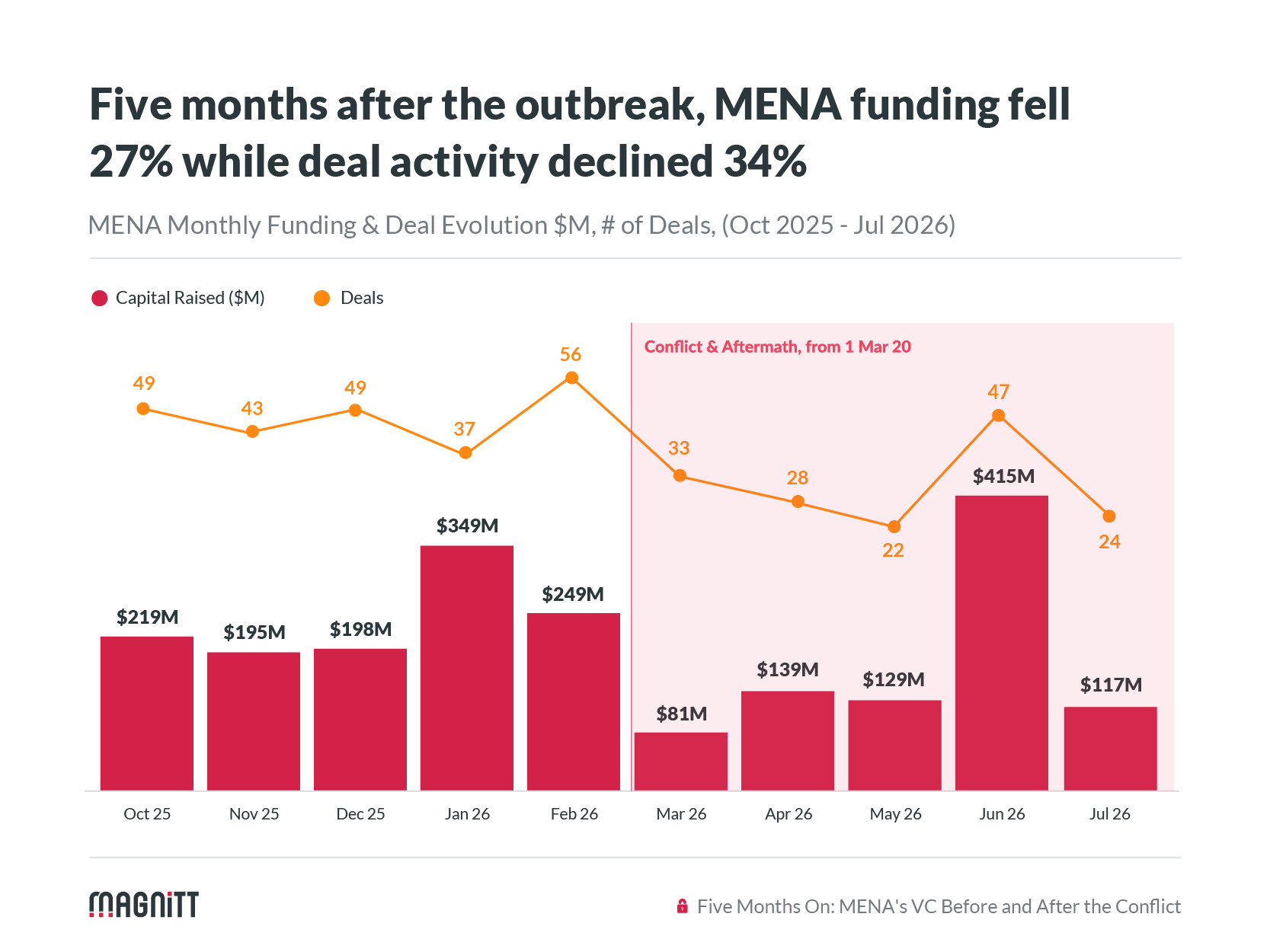
Five months after the outbreak of the regional conflict, MENA venture activity is operating at a lower level. Startups raised $881M across 154 deals between March and July 2026, down 27% in funding and 34% in deal activity compared with the preceding five months.
But the decline has not been uniform. Early-stage funding fell 72%, Series A remained broadly stable, international capital deployment weakened materially, and exits declined as international acquirers pulled back. Late-stage weakness, meanwhile, predates the conflict altogether.
That distinction matters. This report does not assume every post-February movement was caused by the war. Instead, it uses two equal five-month windows to show where the market changed after the conflict outbreak, where resilience remained, and which vulnerabilities were already embedded in MENA's venture cycle.
📊 Key Takeaways
- Deal activity contracted faster than funding. MENA startups raised $881M across 154 deals from March through July, compared with $1.21B across 234 deals in the preceding five months, reducing funding by 27% and transactions by 34%.
- Early stage recorded the clearest deterioration. Pre-Seed and Seed deals fell 44%, while capital declined 72% to $130M, cutting early-stage funding's share of the market from 38% to 15%.
- The middle of the funding funnel proved more resilient. Series A funding declined just 4% to $215M and Series B funding declined by 5% to $130M. The absence of Series C+ activity cannot be attributed solely to the conflict, with the last such round recorded in July 2025.
- International participation held up better than international capital. International investors represented 39% of active investors in 2026 YTD, but only 23% of attributed capital, compared with 49% of capital in 2025.
- Liquidity and future capital formation also weakened. M&A transactions fell from 15 to 12, driven by fewer international acquirers, while new fund announcements declined from eight to five and announced target capital excluding the $49B MGX AI Fund fell 63%.
🎯 Who Should Read This Report
This update is for those looking to get an in-depth understanding of MENA's startup and VC ecosystem.
- VCs and GPs assessing where deal formation has weakened and which stages continue to support deployment opportunities.
- LPs and institutional allocators monitoring whether geopolitical uncertainty is translating into lower fund activity, reduced international deployment, or structural changes in regional capital formation.
- Family offices and sovereign investors evaluating where domestic and regional capital may need to play a larger role as international deployment becomes more selective.
- Policymakers and ecosystem stakeholders tracking whether weaker startup formation, exit liquidity, and fund announcements are creating longer-term constraints for the venture ecosystem.
- Corporate investors and acquirers assessing the changing role of regional versus international buyers in MENA's exit market.
- Advisors and consultants requiring a consistent before-and-after framework for evaluating the market impact of the 2026 conflict.
Where is this data from?
The report was created using MAGNiTT's proprietary data platform, the leading VC and PE intelligence platform across the Middle East, Africa, Pakistan, Türkiye, and Southeast Asia. With data on 34,800+ startups, 22,500+ funding rounds, and 1,300+ exits, MAGNiTT provides one of the region's most comprehensive technology datasets.
The MGTI combines MAGNiTT's proprietary venture intelligence with publicly available market data, including exchange filings, company disclosures, share prices, free-float market capitalisation, liquidity metrics, and benchmark indices. Updated quarterly, the index provides a transparent and consistent measure of MENA's listed technology sector.
Learn how MAGNiTT can help your business today!