Thinning at the Top: What MENA’s Early-Stage Slowdown Means for the Ecosystem, and the Path Forward
After strong early-stage activity in 2024 and 2025, MENA’s startup funding pipeline slowed in 9M 2026. Early-stage deals fell 42% YoY, while the seven-month comparison before and after the conflict showed a 35% decline. Investor participation also weakened, even as MENA-based investors accounted for a larger share of early-stage activity.
Lower deal flow raises questions about how many startups are entering the pipeline and how many will progress to later rounds. This report tracks early-stage activity, investor participation, and median deal sizes, alongside graduation to Series A and beyond. Comparing MENA-wide trends with a closer look at the UAE and KSA, and considers what a sustained slowdown could mean for the funding pipeline ahead.
Explore the report for a closer view of the forces shaping MENA’s early-stage ecosystem through 9M 2026.
📊 Key Takeaways
- MENA early-stage deal activity fell 43% YoY in 9M 2026, with deals down around 35% in the seven-month post-conflict comparison.
- Investor participation declined 22% YoY, while MENA-based investors’ share rose to 66%, up from 51% in 9M 2025.
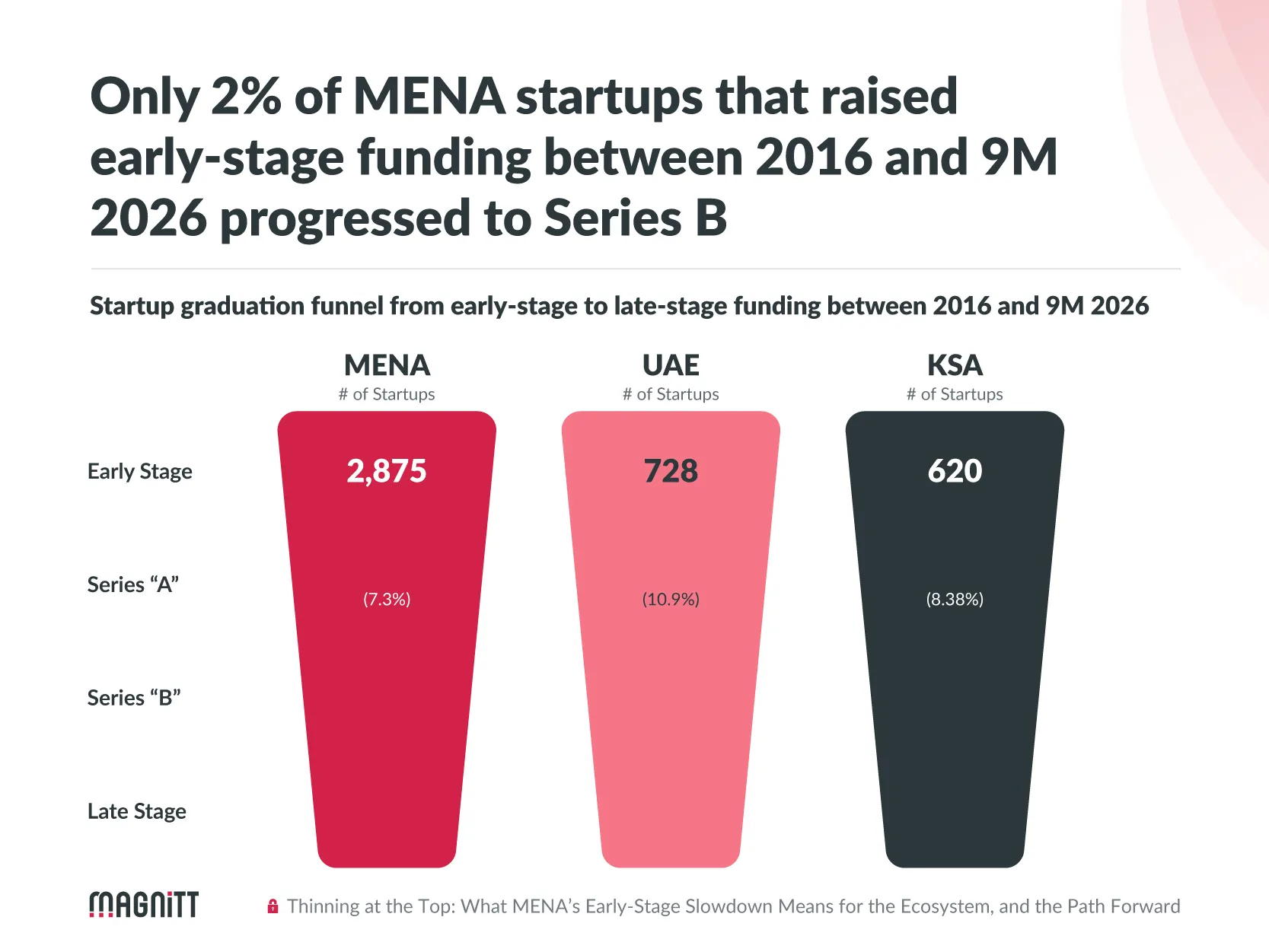
- The funding funnel narrows sharply: 7.3% of early-stage-funded startups reached Series A, 2% reached Series B, and 0.35% reached late stage.
- The UAE had higher Series A progression than KSA (10.9% vs. 8.4%), while KSA had a higher share reaching late stage (0.8% vs. 0.4%).
- A prolonged slowdown could leave a thinner Series A and B pipeline in 2027–28, while stronger competition for the most promising companies may put pressure on valuations.
🎯 Who Should Read This Report
This report is for investors, founders, and ecosystem stakeholders tracking MENA’s early-stage funding pipeline, how startups progress to later rounds, and how activity is changing across the UAE and KSA
- Limited Partners and institutional investors assessing early-stage capital deployment and future pipeline health.
- General partners and venture investors benchmarking deal flow, investor participation, deal sizes, and graduation rates.
- Founders understanding where early-stage capital is available and what the path to follow-on funding looks like.
- Corporates, policymakers, and ecosystem builders monitoring company formation, startup progression, and the region’s long-term pipeline.
- Government agencies shaping startup and investment policy, and assessing where targeted support could strengthen early-stage funding and company growth.
Where is this data from?
To create MAGNiTT Tech Index (MGTI), MAGNiTT combined proprietary venture data with verified public-market data, including exchange filings, annual reports, share price history, free float market capitalization, liquidity metrics, FX data, and public disclosures. The index methodology applies a documented screening process covering MENA headquarters, verified technology revenue, minimum free float market capitalization, trading liquidity, and continuous post-listing trading history.
With data on 34,800+ startups, 22,500+ funding rounds, and 1,300+ exits, MAGNiTT offers a comprehensive directory of technology innovation trends.
Learn how MAGNiTT can help your business today!